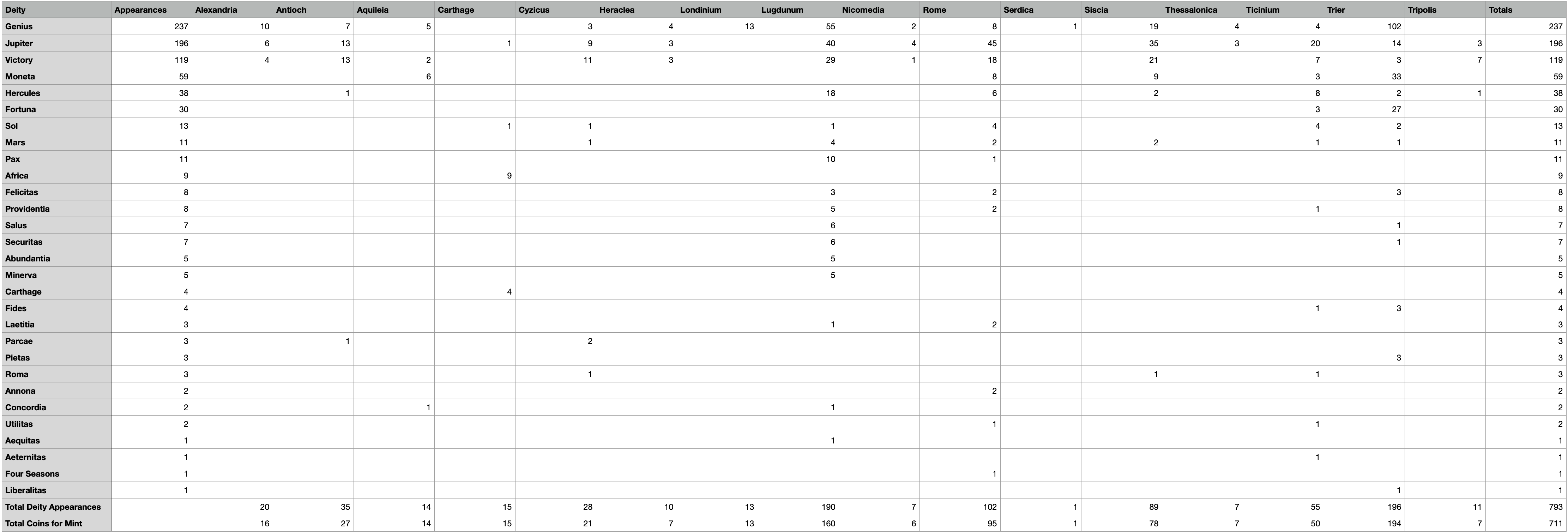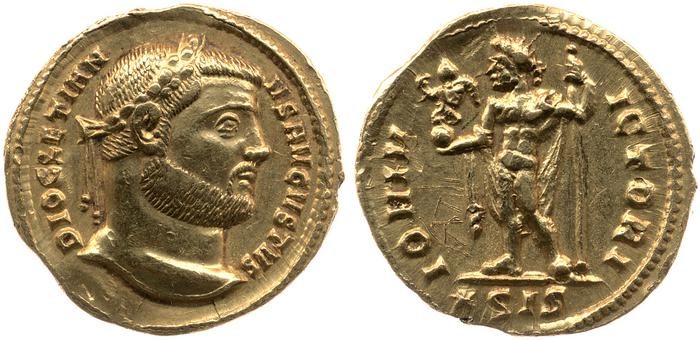

Beginning with the dyarchy, Diocletian and Maximian each had signa that represented the two men as individual but connected rulers. Jupiter, the chief Roman god, represented Diocletian, while his son, Hercules, served as the signum for Maximian, permitting the emperors to claim divine agency. Additionally, each Caesar used the signum of their associated Augustus.[1] The uses of these signa are most apparent in numismatic sources. Numerous coins featuring Diocletian on the obverse include a scene of Jupiter on the reverse, and other coins feature scenes with both Jupiter and Hercules. The coins that stand out the most for understanding the unity of these two Augusti are the coins featuring Jupiter, Hercules, and Victory. However, Jupiter is not the deity most found in Diocletianic coinage. The claim goes to Genius.
237 of the 711 coins minted throughout the empire feature Genius, while 196 of those coins feature the familiar Jupiter. All coins featuring Genius include the slogan on the coin’s reverse with Genius, “GENIO POPULI ROMANI,” which translates as “to the genius of the Roman people.” Each of these coins displays the universal image of Genius nude but whose left should is draped by a chlamys and wearing a modius as genius pours liquid from a patera held in their right hand as their left hand grasps a cornucopia.[2] Coins featuring Genius do not appear to have been minted before 294, only arriving after the tetrarchy’s formation. Possibly, Diocletian did not invent the idea for this style of the coin, but it carried his image and showed his imperial power to the people of Rome while uniting them behind a collective genius. Rees provides commentary for this particular coin style. The coin emerged after an empire-wide coin reform that brought change to the location of mints and the types of coins.[3] The overhaul of the production of Roman coins demonstrates that Diocletian saw this period as a time of significant change, and he needed the means to express his imperial power to the people of Rome. The tetrarchy formed in 293, and the coin reform occurred in 294. The coin reform allowed Diocletian to issue much of the coins previously discussed. These coins benefitted Diocletian as great propaganda tools for both showing a unified tetrarchy, a unified people, and thus a unified Roman empire.
[1] Rees, Diocletian and the Tetrarchy, 54-55.
[2] For example, see RIC VI Heraclea 19a, Online Coins of the Roman Empire, http://numismatics.org/ocre/id/ric.6.her.19a.
[3] Rees, Diocletian and the Tetrarchy, 40-41.
For other broad findings, see the images below.